
Last updated on August 7th, 2024 at 04:29 pm
The governments of Ireland, Norway, and Spain are all moving together on a plan to recognize a Palestinian state, in a move frustrating Israeli officials.
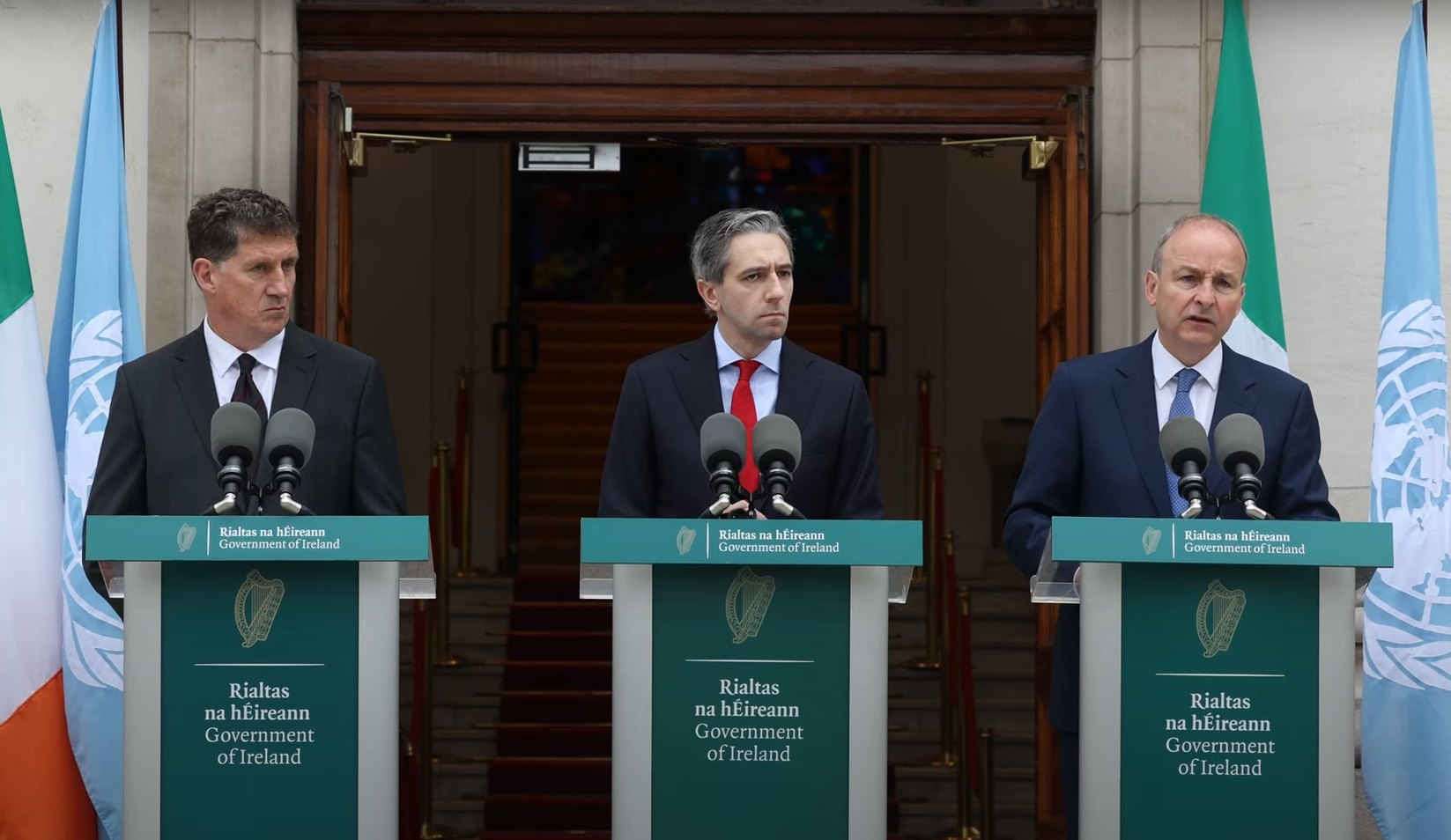
Today, Ireland, Norway, and Spain are announcing that we recognize the state of Palestine. Each of us will now undertake whatever national steps are necessary to give effect to that decision,” Irish Prime Minister Simon Harris said at a Wednesday press conference, flanked by Norwegian counterpart Jonas Gahr Støre, and Spanish counterpart Pedro Sanchez.
The trio announced they would move ahead with their respective measures to recognize Palestine as its own state by May 28.
The move comes as efforts to recognize Palestinian statehood through full United Nations membership have faltered. Some 140 of the U.N.’s 190 member nations already recognize a Palestinian state, but full U.N. membership is contingent on approval from the 15-member U.N. Security Council.
While the move by Ireland, Norway, and Spain would raise the number of U.N. members recognizing a Palestinian state to 143, it won’t impact Palestine’s membership status within the U.N.
Still, the move raises the degree of international support for a Palestinian State, despite the opposition of the current Israeli government.
Palestinian Statehood: History
The decades-old Israel-Palestine conflict has centered around who should control the land of the former British Mandate of Palestine. Many Palestinians currently living in the region are descendants of those who lived in the region back when it was under Ottoman control, and then under British rule after the First World War. Beginning in around the 1900s, the Zionist movement consisting of predominantly European Jewish people began to settle in the region, at times claiming a right to inherit the land by virtue of an ethno-religious link to the Jewish people of the Biblical Land of Israel. The Zionist project raised tensions between the new and predominantly European Jewish settlers and the predominantly Muslim population living in the land prior to their arrival.
The Zionist movement escalated their efforts for control over territory in Mandatory Palestine and the establishment of a Jewish state, following the Holocaust and the deaths of millions of ethnic Jews in Europe during the Second World War.
The United Nations, which formed following the Second World War, planned to partition the land in a move that would withdraw the British mandatory government and split the land into a Jewish state and an Arab state. The November 1947 U.N. partition plan proposed granting about 56 percent of the mandatory land for the Jewish state and about 42 percent for the Arab State, with the balance of two percent consisting of Jerusalem and Bethlehem, which have religious significance for both Jews and Muslims.
The Arabs of the Palestinian mandate opposed the partition, arguing that it unfairly favored the Zionist settlers who, to that point, had a more limited presence in the land than the partition allotted them. The Zionist settlers, by contrast, took the plan as a substantial starting point for their Jewish state. Ethnic tensions and violence rose in the land following the U.N. vote approving the partition plan. The Zionist movement began to enforce the U.N. partition, through a declaration of Jewish statehood, within hours of the termination of the British mandate on May 14, 1948.
Even prior to the statehood declaration, Zionists had used a variety of tactics, including killings and intimidation, to push ethnic Arabs out of the territory granted to a Jewish state under the U.N. partition. The existing tensions boiled over into a full-scale war following the Israeli declaration of statehood, with the surrounding Arab nations entering the old British mandate to contest Israeli land claims. The resulting conflict saw the Israeli forces expel the armies of the surrounding Arab states beyond the old British mandate and assert control over about 78 percent of the old British mandate. The Arabs living within the British mandate fled to the remaining 22 percent of the land.
Israeli forces gained control over the remaining British mandate land during the 1967 “Six Day War.” That war saw Israeli forces launch what they deemed a preemptive strike to deter a suspected invasion by neighboring Arab nations. The Arab opponents of Israel contend that the Israeli side was the aggressor.
Israel has maintained some level of control over the Gaza Strip and the West Bank since the 1967 war, despite a U.N. Security Council resolution that year calling for Israeli armed forces to withdraw from those territories. Israeli settlers have, for decades, built settlements within parts of the West Bank, despite another 2016 U.N. resolution declaring new settlements unlawful and calling on Israeli authorities to halt the practice.
Negotiations for a two-state settlement in the Israel-Palestine conflict have continued in the years since the 1967 war, but have not resulted in a final agreement between Israeli leaders and Palestinian counterparts, or U.N. membership for Palestine.
In a September 2023 speech before the United Nations, Israeli Prime Minister Benjamin Netanyahu contended that Israeli could normalize relations with the various its Arab neighbors without first agreeing to grant a Palestinian state. He further argued the Palestinian cause should not impede Israel from normalizing relations with the broader Arab world.
“For peace to prevail the Palestinians must stop spewing Jew-hatred and finally reconcile themselves to the Jewish state,” Netanyahu said in his September U.N. speech. “By that I mean not only to the existence of the Jewish state but to the right of the Jewish people to have a state of their own in their historic homeland, the Land of Israel.”
During the September speech, Netanyahu shared a pair of maps, depicting a single blue state of Israel in 1948 and in the present day as a single continuous land mass encompassing the West Bank and the Gaza Strip.

Netanyahu’s use of these graphics sparked criticism, with Palestinian Ambassador to Germany Laith Arafeh stating at the time that the Israeli leader was “negating Palestine and its people, then attempting to spin the audience with rhetoric about ‘peace’ in the region.”
Hamas members and other Palestinian militants launched the Oct. 7 attacks inside Israel just over two weeks after Netanyahu’s U.N. remarks, setting off renewed fighting and heightened tension over the long-running conflict. Separate from the Israeli military operation in the Gaza Strip, there have been renewed clashes in the West Bank involving Israeli security forces, Israeli settlers, and Palestinians. Israeli officials have also advanced efforts to develop even more settlements in the West Bank in recent months.
Israeli Officials Condemn Ireland, Norway, and Spain
The Israeli government has opposed efforts to advance a Palestinian state amid the ongoing Israeli operations in the Gaza Strip.
Last month, the U.S. delegation to the U.N. cast the sole vote against a Security Council Resolution recommending full Palestinian membership within the international body. As one of five permanent members of the Security Council, the United States has veto power that the rest of the council cannot override. The U.S. veto earned the approval of the Israeli delegation to the U.N., and Israeli U.N. delegate Gilad Erdan accused those who voted in favor of the resolution of attempting to “reward Palestinian terror with a Palestinian state.”
Israeli officials continued their condemnation of efforts to recognize Palestinian sovereignty on Wednesday as the prime ministers of Ireland, Norway, and Spain moved ahead on the issue.
“The intention of several European countries to recognize a Palestinian state is a reward for terrorism. 80% of the Palestinians in Judea and Samaria support the terrible massacre of October 7,” Netanyahu said Wednesday. “This evil cannot be given a state. This would be a terrorist state. It will try to repeat the massacre of October 7 again and again; we will not consent to this. Rewarding terrorism will not bring peace and neither will it stop us from defeating Hamas.”
Israeli Foreign Minister Israel Katz similarly accused Ireland, Norway, and Spain of rewarding terrorism. Katz further announced he had immediately recalled the Israeli ambassadors to Ireland and Norway and threatened the same action with Spain if it took further steps to recognize Palestinian statehood.
Author

Discover more from FreeBase News
Subscribe to get the latest posts sent to your email.
