
Last updated on August 9th, 2024 at 02:19 pm
The 8th U.S. Circuit Court of Appeals ruled on Aug. 9 that a rule by the U.S. Bureau of Alcohol, Tobacco, Firearms, and Explosives (ATF) to regulate firearm braces is likely too arbitrary to survive legal scrutiny.
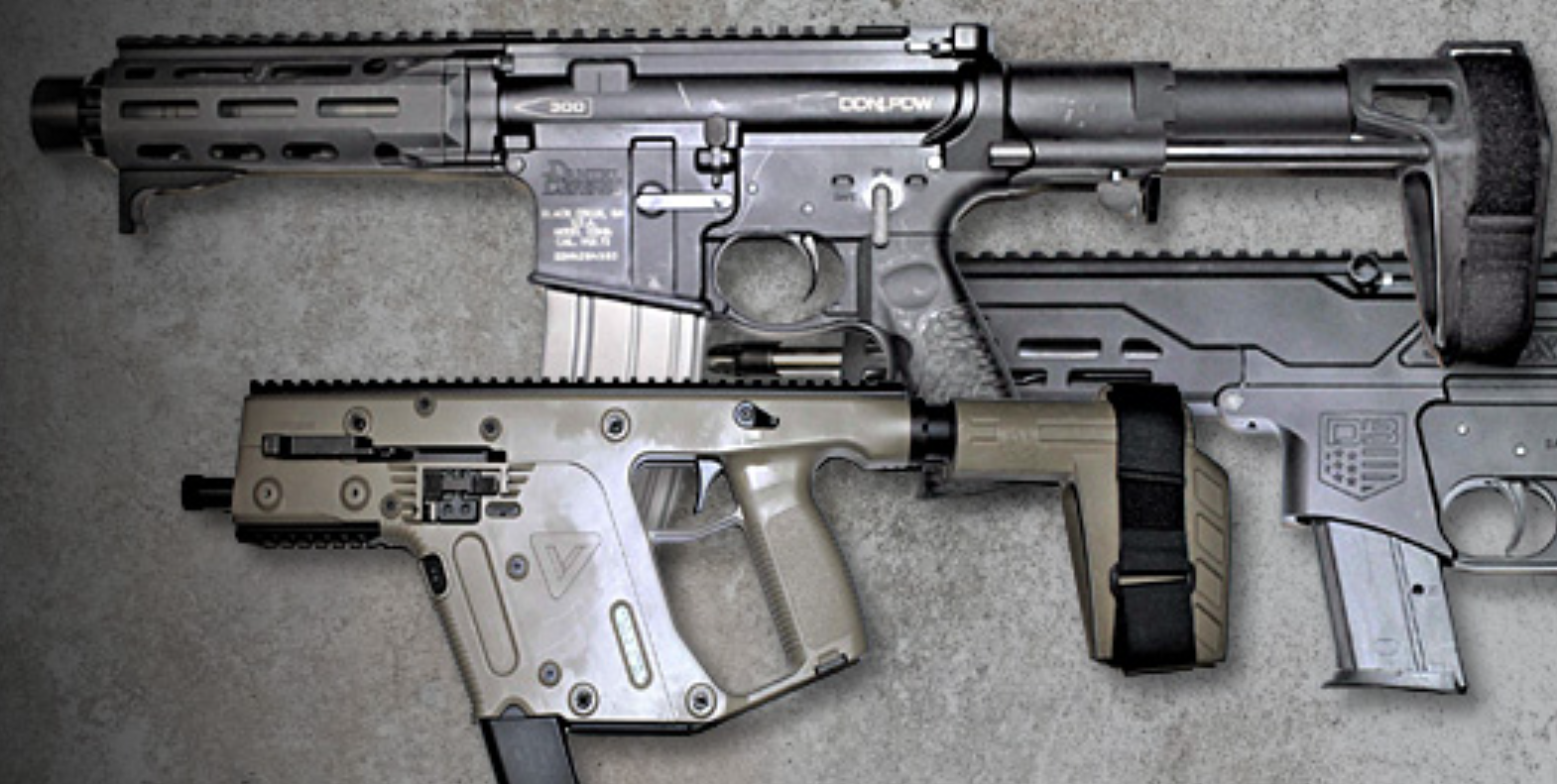
The ATF rule in question rule in question—dubbed the “Factoring Criteria for Firearms with Attached ‘Stabilizing Braces'”—proposes a scoring system for determining whether a stabilizing brace attached to a firearm makes that firearm a short-barreled rifle (SBR) in the eyes of the federal government.
A group called the Firearms Regulatory Accountability Coalition, challenged the ATF rule in the U.S. District Court for North Dakota. Joining them in the lawsuit was a wounded U.S. Army veteran and amputee named Richard Cicero and SB Tactical, a producer of firearm stabilizing brace products. Also joining them were the attorneys general of West Virginia, North Dakota, Alabama, Alaska, Arkansas, Florida, Georgia, Idaho, Indiana, Iowa, Kansas, Kentucky, Louisiana, Mississippi, Missouri, Montana, Nebraska, New Hampshire, Ohlahoma, South Carolina, South Dakota, Tennessee, Utah, Virginia, and Wyoming.
The plaintiffs argued the ATF factoring framework is “arbitrary and capricious” and violates the Administrative Procedure Act (APA), which generally states that executive branch agencies must have clear authorization from Congress to set new regulations.
The North Dakota district court initially rejected the plaintiff’s request for a preliminary injunction blocking the ATF from enforcing its rule while the lawsuit plays out.
The appeals court reversed the lower court’s decision in a 2-1 ruling on Friday. Judges Raymond Gruender and L. Steven Grasz ruled that the plaintiffs were likely to succeed on their claims and thus reversed and remanded the lower court’s decision.
“Though the Final Rule does not ban stabilizing braces or braced weapons that are ‘short-barreled rifles,’ the consequences of possessing a braced weapon deemed to be a ‘short-barreled rifle’ are dire: that firearm and the person who possesses it are subject to the [1934 National Firearms Act’s] and [1968 Gun Control Act’s] stringent regulations and serious criminal penalties for non-compliance,” the court’s majority wrote.
The court’s majority noted the ATF estimated between three million and seven million braces are out in circulation throughout the country. They added an untold additional number of braces were sold between 2020 and the publication of the ATF brace rule in January 2023.
“The Final Rule does the job of reclassifying these millions of braced weapons—and those who possess them—as violating the NFA and GCA,” the majority wrote.
Judge Bobby Shepherd took the opposing view on Friday, arguing that there was no real rule left to enjoin after Judge Reed O’Connor of the U.S. District Court for the Northern District of Texas vacated the ATF rule in a separate lawsuit in June.
“During the pendency of this appeal, the Northern District of Texas vacated the Final Rule,” Shepherd wrote in a two-and-half page response. “. . .I therefore see no need to preliminarily enjoin the enforcement of the now-vacated Final Rule and would affirm the district court’s order on that basis alone.”
Author

Discover more from FreeBase News
Subscribe to get the latest posts sent to your email.
