
Last updated on November 13th, 2024 at 12:46 pm
A pair of U.S. warships intercepted a barrage of missiles and explosive drones launched by the Houthi rebels in Yemen on Nov. 11, the Pentagon has confirmed.
The Houthis claimed to have launched attacks targeting the aircraft carrier USS Abraham Lincoln in the Arabian Sea and two other U.S. warships operating in the Red Sea.
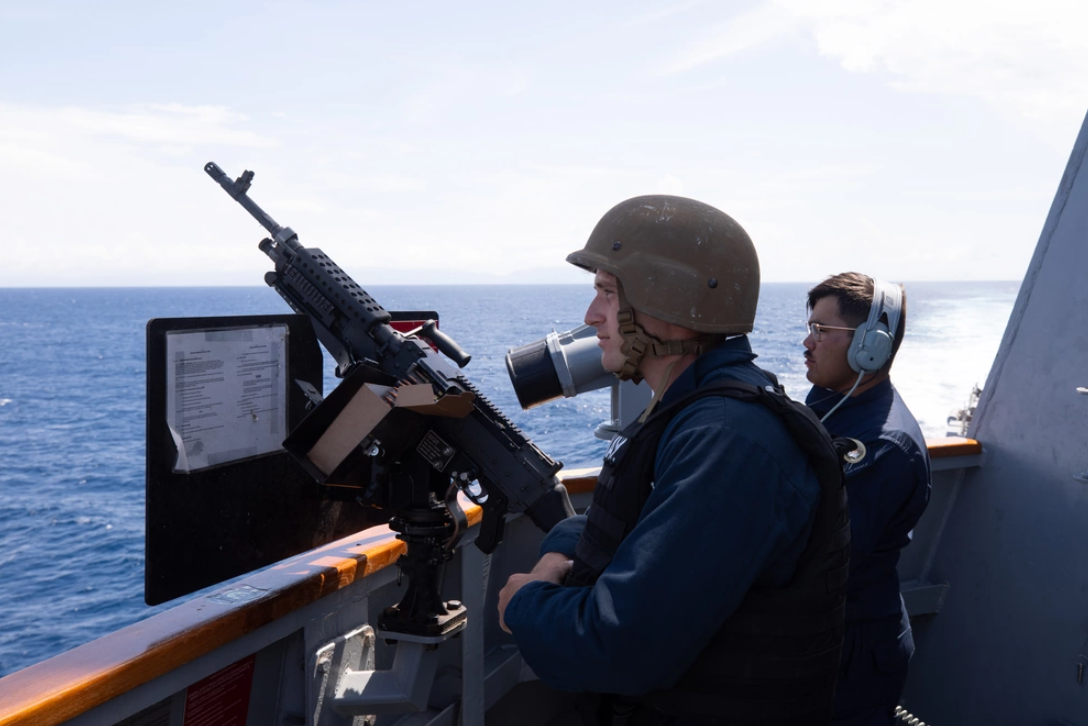
Pentagon press secretary and U.S. Air Force Maj. Gen. Pat Ryder confirmed, at a Nov. 12 press briefing, that Houthi drones and missiles targeted Arleigh Burke-class guided-missile destroyers USS Stockdale and USS Spruance. Ryder said the Houthis launched at least eight one-way explosive attack drones, five anti-ship ballistic missiles, and three more anti-ship cruise missiles at the pair of U.S. warships on Nov. 11.
Ryder reported the U.S. warships successfully blocked the attacks.
“The vessels were not damaged, no personnel were hurt,” he added.
The Pentagon spokesman said he was not aware of any attacks targeting the USS Abraham Lincoln.
Ryder said the Houthi attacks came after U.S. forces conducted multiple airstrikes on Nov. 9 and 10, striking suspected Houthi weapons storage sites across Yemen.
“These facilities housed a variety of advanced conventional weapons used by the Iran-backed Houthis to target U.S. and international military and civilian vessels navigating international waters in the Red Sea and Gulf of Aden,” Ryder said.
These recent U.S. airstrikes involved both U.S. Air Force and U.S. Navy aircraft, including Navy F-35C stealth fighter jets.
For over a year, the Houthis have maintained a campaign of attacks across Middle Eastern sea lanes, targeting both commercial vessels and warships alike. They claim their actions are in support of the Palestinian cause and will continue until Israel halts its military operations in Gaza and Lebanon, against Hamas and Hezbollah respectively.
Over the past year, the Houthis have damaged dozens of commercial ships and sunk two; the Belize-flagged bulk carrier MV Rubymar, and the Liberia-flagged and Greece-owned bulk carrier MV Tutor. The Houthis also seized the Bahamas-flagged vehicle carrier MV Galaxy Leader and took its crew of 25 as hostages in a helicopter-borne assault in November of last year.
The U.S. military has rotated three carrier strike groups (CSGs) through the Middle East over the past year in response to the Houthi attacks and the broader interconnected conflicts throughout the Middle East.
The USS Dwight D. Eisenhower CSG was the first to rotate into the region, followed by the USS Theodore Roosevelt, and then the Lincoln CSG.
Last week, Ryder announced the Lincoln CSG was leaving the CENTCOM area of operations, but other U.S. military resources are rotating into the region, including B-52 bombers.
B-2 Spirit stealth bombers also made a recent appearance in the region, to conduct strikes on Houthi targets in Yemen.
“We will continue to make clear to the Houthis that there will be consequences for their illegal and reckless attacks,” Ryder said Tuesday.
The Houthis are a primarily Shia Muslim faction and have fought with Yemen’s predominantly Sunni Muslim government for years. In that time, the Houthis have seized control of the Yemeni capital city of Sana’a and established de-facto control over large swathes of western Yemen. The Yemeni internal conflict has subsided since a ceasefire was established in the spring of 2022.
The U.S. government has gone back and forth over whether to consider the Houthis a terrorist organization.
Under President Barack Obama, the U.S. government supplied weapons and some intelligence and logistical support for a Saudi Arabian-led coalition that intervened in the civil war on the side of Yemen’s Sunni Muslim government. Despite this support, the Obama administration didn’t formally designate the Houthis as terrorists.
Under President Donald Trump’s first term in office, the U.S. government continued to support the Saudi coalition, but didn’t apply any terrorism designations against the Houthis until Jan. 19, 2021, Trump’s last full day in office. The outgoing Trump administration specifically designated the Houthis as both a specially designated terrorist group (SDGT) and a foreign terrorist organization (FTO). President Joe Biden’s administration reversed those terror designations just days later when he took office.
The Biden administration reapplied the SDGT designation in January of this year, as the Houthi attacks along the Middle Eastern sea lanes grew. The Biden administration had suggested it would have considered removing the SDGT label yet again, if the Houthis ceased their attacks.
It doesn’t appear likely that the Houthis will change course before Biden leaves office in January. It remains to be seen how a second Trump administration will approach the Houthis.
Author

Discover more from FreeBase News
Subscribe to get the latest posts sent to your email.
